

























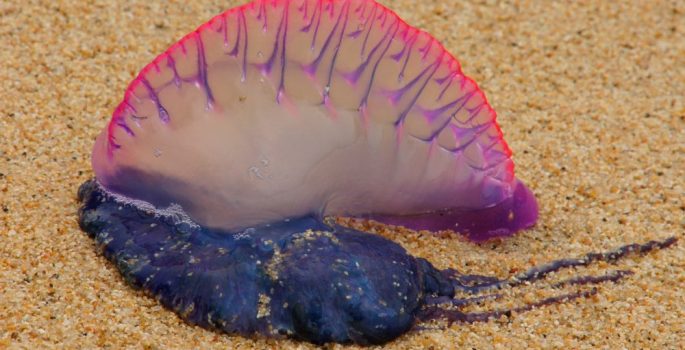
La Fragata Portuguesa, related species of jellyfish, It is distributed by all the planet warm waters, especially in tropical and subtropical waters of the Atlantic, Pacific and Indian. In the department of La Guajira, its presence in coastal waters appears to be temporary, and although not scientifically clear, may respond to transient changes in ocean characteristics, mainly water currents and wind intensity.
Although this species has a physical appearance of jellyfish, This is not actually a jellyfish, but a colonial animals floating, i.e., a colony of organisms that are associated to survive, fulfilling different functions: feeding, reproduction and defense. Commonly it is known as false or jellyfish Frigate Portuguese, It is its scientific name Physalia physalis.
This animal belongs to the phylum Cnidaria, As to the corals, jellyfish, and anemones, by sharing presence of specialized cells called nematocysts, which they are constituted by a closed cavity cells harboring a paralyzing toxin, which injects its prey (fish and plankton) or optionally having contact with.
However, at sea these individuals are easily recognized by the presence of a float (neumatóforo), bright blue, which helps them navigate and float on the surface of the sea, with a maximum length of 134 mm and a diameter of 65.1 mm.
They have been identified as predators of Fragata Portuguesa, the loggerhead turtle Caretta caretta and hawksbill Eretmochelys imbricata, species subject to catch and illegal trafficking in the Department of La Guajira.
The Corporation makes a call to the community to inform immediately if they notice the presence of this species in the sea or on the coast, our hotline citizen: 7275125 / 7283518.
precautions:
- Avoid all contact to observing a specimen or remains of this.
- If the saw in the sea you have to get away quickly as the tentacles may be present in the surrounding vicinity over 10 meters.
- You need to be very careful if you are a dead specimen on the coast because its venom continues still active when they are inert.
- Call the hotline to the citizen CORPOGUAJIRA and report the sighting of the species in beach or sea.
If contact occurs:
- Do not rub the affected area with sand or, nor towel or clothing.
- Remove the remains of tentacles, take avoiding direct contact with them.
- Wash with sea water or physiological serum (Do not use fresh water because it can activate more toxin), once thoroughly washed the affected area, in order to relieve pain, apply a cold compress by 5 – 10 minutes.
- It is important, to present any symptoms such as feeling of extreme skin burn, tachycardia, sickness, dizziness, headache or joint, alterations pulse, swelling, etc., go to the nearest health center.
Leave a reply
I am sorry, you should be connected to post a comment.