




























This was reported by the United States Agency for International Development – USAID and the Institute of Hydrology, Meteorología y Estudios Ambientales – Ideam.
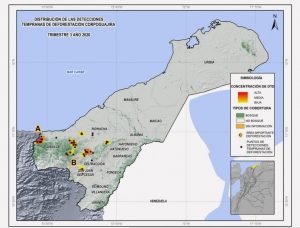 From the project «Early Detection of Changes in Key Ecosystems of the Caribbean and the Colombian Orinoquía», led by the Natural Wealth Program, from the United States Agency for International Development (USAID) and the Institute of Hydrology, Meteorology and Environmental Studies (Ideas), it was determined that during the third quarter of 2020 In the department of La Guajira, two important areas of deforestation and 45 early detections of deforestation in the municipalities of Riohacha, Dibulla and San Juan del Cesar.
The deforestation points were located in the hydrographic subzones of the Tapias River, Rio Ancho Others Direct to the Caribbean, Ranchería River and Alto Cesar.
Regarding the early zones of deforestation, the townships of Cotoprix, Las Palmas, Tigreras and Matitas, and the Kogui-Malayo-Arhuaco reservation in the jurisdiction of Riohacha are key points. The main cause of deforestation in this sector corresponds to the expansion of the agricultural frontier in prohibited areas, through burns that affect natural forest areas and, to a lesser extent, illegal logging.
Meanwhile, in Dibulla, in the townships of Mingueo, Palomino and Punta de los Remedios, the main cause of deforestation is associated with the expansion of the agricultural frontier in prohibited areas and to a lesser extent with crops for illicit use.
In the town of Caracolí and the Cardones paths, La Peua and Sabana Grande, jurisdiction of San Juan del Cesar, deforestation is a product of the agricultural frontier in areas not allowed through burns that affect areas of the natural forest.
Corpoguajira will continue to exercise control and surveillance of natural resources and will continue to bet on the conservation and care of biodiversity.
Leave a reply
I am sorry, you should be connected to post a comment.